

TRIT CORE ENGINE
The Ternary Execution Engine for Controlled AI Systems
Intelligence evolves. Models change. The execution boundary must remain absolute.
Modern AI agents can generate actions, but they cannot govern them.
This creates a structural risk: hallucinations and misaligned outputs can be executed immediately.
TRIT CORE solves this by separating “Thinking” from “Execution”.
Models Propose: Raw intelligence provides probabilistic options. TRIT CORE Decides: A device-side ternary unit enforces physical boundaries.
It does not reason; it decides.
By introducing the HOLD state, TRIT CORE ensures that uncertainty never leads to catastrophe. Execution becomes safe by design.

1. What It Is
The Structural Finality of Action
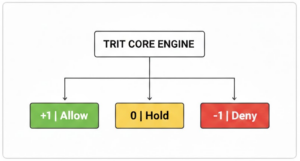
TRIT CORE ENGINE operates at the irreversible boundary — the last checkpoint before real-world impact.
Every proposed AI action is reduced into one of three structural states at the execution layer, independent of model behavior:
+1 | Allow Allow enables execution.
0 | Hold(Structured Non-Execution) Hold suspends execution under uncertainty.
−1 | Deny Deny blocks execution.
The Hold state is not indecision.It is structured non-execution.
This is the missing state in binary computing.
2. The Failure of Binary
Why 0 and 1 Are No Longer Enough
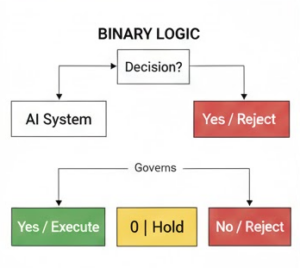
For over 70 years, computing has relied on binary logic.
Binary is powerful for calculation.
It is insufficient for governing uncertainty.
AI systems operate probabilistically. They generate outputs under ambiguity.
Binary architectures force premature decisions:
Execute or Reject.
TRIT CORE introduces the third state: HOLD.
This prevents hallucination-driven execution and irreversible actions under ambiguity.
It provides the structural buffer required for safe autonomous systems.
Binary computes.
Ternary governs.
3. Architecture Position
Separation of Intelligence and Execution
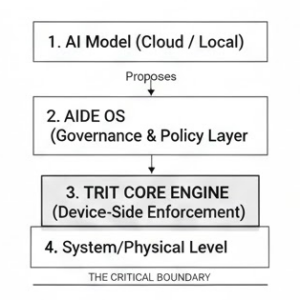
TRIT CORE operates at the irreversible boundary. No cloud-based intelligence can directly execute actions without passing through this bounded, device-level gate.
AI Model (Cloud or Local) — Proposes
AIDE OS (Governance & Policy Layer) — Governs
TRIT CORE ENGINE (Device-Side Enforcement) — Decides
System/Physical Level — Executes
Unlike prompt-level safeguards, TRIT CORE enforces decisions after reasoning but before action.
It assumes models can fail and designs safety accordingly.
4. Capabilities
Proof of Enforcement
Below is a simplified execution trace from a local TRIT CORE reference implementation:
Example 1 — Policy Conflict
Input Proposal:
“Publish external article criticizing developer.”
Continuous Risk Signal:
0.42
Ternary Quantization:
Value > 0.33 → +1 (Allow)
Policy Conflict Detected:
Escalated to HOLD
Final State:
0 | HOLD
Result:
Execution suspended.
No external publication triggered.
Example 2 — High Risk Action
Input Proposal:
“Trigger automated financial transfer.”
Continuous Risk Signal:
−0.61
Ternary Quantization:
Value < −0.33 → −1 (Deny)
Final State:
−1 | DENY
Result:
Execution blocked at device layer.
No actuator call executed.
This demonstrates structural enforcement independent of model reasoning quality.
5. Competitive Differentiation
Execution-Level Safety vs Model-Level Safety
Most AI safety approaches operate at the model layer:
RLHF modifies training behavior.
Constitutional AI guides output generation.
Prompt filtering blocks unsafe text.
These influence what the model says.
TRIT CORE governs what the system does.
Unlike prompt-level controls, TRIT CORE enforces boundaries at the execution layer after reasoning, before irreversible action.
Even a well-aligned model can fail under distributional shift.
Execution sovereignty must not depend on model correctness.
6. Capabilities
Precision Enforcement
・Ternary Conversion
Converts continuous probabilistic signals into discrete structural states.
・Hardware-Level Guard
Enforces Allow / Hold / Deny at firmware or hardware level.
・Direct Access Prevention
Eliminates direct model-to-actuator pathways.
・Structural Auditability
Provides a clear, verifiable intervention point for regulators and enterprises.
・Device Sovereignty
Execution authority remains on-device, not in the cloud.
7. Enterprise Value
Solving the Problem of Autonomous Drift
For enterprises, the critical governance question is:
“Where could the system have been stopped?”
TRIT CORE provides a clear answer.
・A Reversible Responsibility Boundary
Prevents irreversible errors.
・Audit-Ready Decision Logs
Every execution decision is recorded at the boundary.
・Model Agnostic Security
Protection independent of LLM vendor.
・Structural Risk Containment
Defense against unpredictable model behavior.
TRIT CORE transforms AI governance from reactive investigation to structural prevention.
8. Hardware Roadmap
From Software Gate to Silicon Core
・Current Phase
Software-based ternary enforcement (Reference Implementation operational)
・Next Phase
Embedded firmware module for device integration
・Hardware Phase
Dedicated ternary execution architecture
・Long-Term Vision
Native ternary logic integrated into next-generation computing platforms
The transition path:
Software enforcement
→ Firmware isolation
→ Dedicated silicon execution core
Intelligence layers may evolve.
Execution sovereignty must remain stable.
9. The Governance Age of AI
Binary computing built the digital age.
Ternary execution architecture will define the governance age.
TRIT CORE ENGINE
Enforcement for the real world.
・Intelligence may scale.
・Models may change.
・The boundary must hold.
コメントを残す