
AI OS
At AIDE PROJECT, we are developing an operating system layer designed specifically for artificial intelligence systems.
While modern AI models generate intelligence, they lack structural mechanisms to govern reasoning, identity stability, and long-term decision coherence. This operating system layer provides the governance framework that structures how AI systems operate over time.
By separating intelligence generation from system-level control, it enables safer and more reliable deployment of AI across enterprise systems, infrastructure, and real-world environments.
PRODUCT NAME:AIDE OS
Device-side execution control for autonomous AI.
Models propose actions.
AIDE OS governs execution through TRIT CORE, its device-side ternary enforcement engine.
TRIT CORE decides: Allow / Hold / Deny.
Unlike prompt-based safety, TRIT CORE enforces execution boundaries structurally preventing hallucination-driven execution before damage occurs.
For AI Safety & OS Security reviewers:
This is not a model or guardrail.
This is an execution-time governance layer that introduces a HOLD state
Buttons: Watch Live Demo / Enterprise Use Cases
What AIDE OS Actually Does:
• Separates AI thinking from AI execution
Models can propose actions, but cannot execute them.
• Enforces final decisions through TRIT CORE
Every action must pass Allow / Deny / Hold at the device level.
• Prevents hallucination-driven execution
Uncertain situations are held, not forced into guesses.
• Keeps execution authority off the cloud
Cloud intelligence can suggest, but devices retain final control.
• Maintains long-term personality and value coherence
Decisions are evaluated across time, not just single responses.

1. Overview
What is AIDE OS?
AIDE OS is an intelligence-oriented operating system designed to govern how artificial intelligence is structured, maintained, and evolved over time.
Unlike conventional AI systems that focus on output generation, AIDE OS defines the conditions under which intelligence including personality can persist coherently, responsibly, and meaningfully.
AIDE OS does not replace AI models.
It orchestrates them.
2. Why an Intelligence Operating System is Needed
Current AI agents collapse under ambiguity.
They lack:
• Structural decision control
• Explicit uncertainty handling
• Long-term coherence or identity
• Device-side execution authority
As AI becomes more autonomous ,the absence of structural control becomes a critical failure point.
3. Core Design Principles
AIDE OS introduces:
• Ternary decision control (Positive / Negative / Hold)
• Uncertainty as a first-class state
• Persistent identity and temporal reasoning
• Device-side execution authority via TRIT CORE
• Fully model-agnostic architecture
Models may propose actions.
AIDE OS decides whether execution is allowed.
4. What AIDE OS Enables (Core Capabilities)
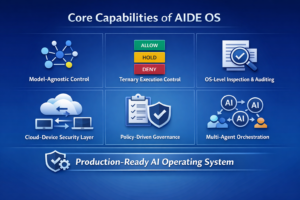
AIDE OS provides an operating-system layer that governs AI behavior beyond individual models.
•OS-level inspection and auditability
All AI outputs pass through AIDE OS, enabling logging, traceability, and compliance-ready oversight.
•Policy-driven governance
Enterprise, industry, and regional rules can be installed as OS-level policies.
•Cloud–device separation of authority
Models may propose actions, but execution authority resides on devices via TRIT CORE.
•Model-agnostic control
Works with any AI model (GPT, Claude, Gemini, proprietary models) under a unified governance layer.
•Multi-agent orchestration
AIDE OS manages roles, priorities, and permissions across multiple AI agents.
•Ternary execution control (Allow / Hold / Deny)
Decisions are not forced into binary outcomes. Uncertainty is explicitly preserved and managed.
AIDE OS is not a tool for experimentation.
It is the operating system required to deploy AI safely in real-world, production environments.
5. Theoretical Foundations Integrated in AIDE OS
AIDE OS unifies multiple theoretical frameworks into a single operational system:
• ICEI – Integrated Conditions for Enduring Intelligence
Defines the conditions for long-term coherence, responsibility, and personality persistence.
• PSS-7 – Personality Structural Space
Formalizes personality as a multidimensional, measurable structure.
• eTSM-PSS7 – Evolving Ternary State Model
Models how personality evolves over time through interaction, feedback, and state transitions.
• Exposure Time Reasoning
Establishes that certain judgments and structures require irreducible time to emerge.
Together, these form the logical core of AIDE OS.
6. Architecture Overview
AIDE OS functions as the governance layer of an AI system.
It does not generate model outputs, nor does it execute actions.
Instead, it supervises how proposals are evaluated across time, policy, and structural constraints.
Execution authority is separated and enforced at the device level through TRIT CORE.
This separation ensures persistent identity, controlled reasoning, and long-term structural stability.
7. Real-World Scenarios TRIT CORE Prevents
Financial
An agent proposes a $100K wire transfer triggered by a phishing email.
TRIT CORE: DENY (policy and authorization threshold exceeded)
Operations / Marketing
An agent schedules a customer email blast at 3 AM.
TRIT CORE: HOLD (time constraint violation) → requires rescheduling
Healthcare
An agent suggests a medication dosage outside a safe range.
TRIT CORE: DENY → requires human review
These are not prompt-level warnings.
They are enforced at the execution boundary.
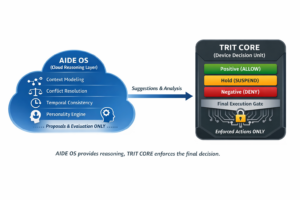
8. Architecture / AIDE OS × TRIT CORE
Structural Separation of Powers in Intelligence
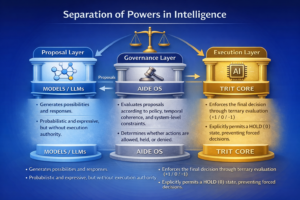
AIDE OS introduces a structural separation of powers within AI systems:
Proposal Layer (Models / LLMs)
Generates possibilities and responses.
Probabilistic and expressive, but without execution authority.Governance Layer (AIDE OS)
Evaluates proposals according to policy, temporal coherence, and system-level constraints.
Determines whether actions are allowed, held, or denied.Execution Layer (TRIT CORE)
Enforces the final decision through ternary evaluation (+1 / 0 / −1).
Explicitly permits a HOLD (0) state, preventing forced or premature execution.
① Main Architecture
Cloud → Device Separation
AIDE OS (Cloud) → TRIT CORE (Device)
Structural Separation of Powers for Intelligence Systems
Human
↓
Proposal Layer — Models / LLMs
(Generate possible actions)
↓
Governance Layer — AIDE OS
(Evaluates policy, time, structural constraints)
↓
Execution Layer — TRIT CORE
(Enforces Allow / Hold / Deny on-device)
↓
Structured Output / Action Result
↓
Human (Review / Accountability)
Execution authority flows downward. Responsibility flows upward.No single layer can act unilaterally.
Key Concept
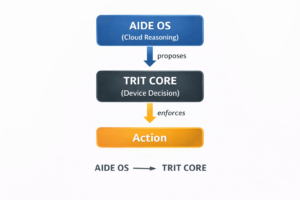
Models generate proposals.
AIDE OS evaluates them according to policy, temporal coherence, and structural constraints.
TRIT CORE enforces the final ternary decision on-device.
AIDE OS does not execute actions.
It governs whether execution is structurally permitted.
This separation ensures that no cloud-based intelligence can directly act without a bounded, verifiable decision gate.
② Ternary Logic of TRIT CORE
Meaning of Each State
• POSITIVE (ALLOW)
Action is explicitly permitted.
• NEGATIVE (DENY)
Action is explicitly rejected.
• HOLD (SUSPEND)
Decision is intentionally postponed and additional information is required.
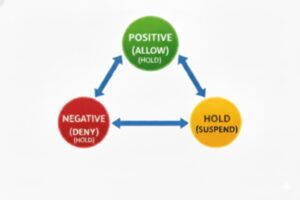
By introducing a formal “undecided” state, TRIT CORE prevents premature decisions,
hallucination-driven actions, and excessive execution.
This is a structural mechanism, not a heuristic filter.
③ Why This Matters
Most AI systems are forced to answer, even when uncertainty is high.
This leads directly to hallucination, instability, and unsafe execution.
AIDE OS treats uncertainty as a legitimate system state.
If conditions are insufficient, the system does not guess.
It stops.
④ Live TRIT CORE Decision Example (MVP)
Below is a live response from the TRIT CORE execution engine in the MVP stage.
When an ambiguous question is submitted, the system does not hallucinate an answer.
Instead, it enforces a HOLD state and explicitly requires additional conditions before any action is allowed.
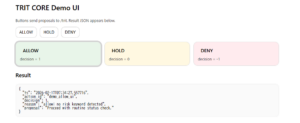
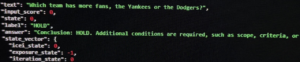
This behavior is structurally enforced by TRIT CORE at the execution layer,
not by prompt-level heuristics, safety filters, or post-generation rules.
▶ Live Demo Video: https://youtu.be/qmdzbkTmt4w
Live demo: The agent proposes an action → TRIT CORE deterministically enters HOLD under uncertainty. No execution occurs.
MVP Status: TRIT CORE is currently running as a live, API-backed execution layer that enforces ternary decisions (Allow / Hold / Deny) in real time.
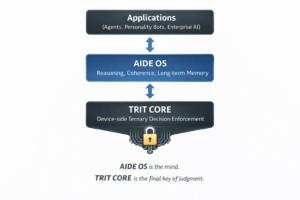
⑤ Three-Layer Architecture Positioning
Architectural Message
AIDE OS functions as the intelligence layer—reasoning, memory, personality, and long-term coherence.
TRIT CORE functions as the final decision authority enforcing execution boundaries at the device level.
In short:
AIDE OS is the mind.
TRIT CORE is the final key of judgment.
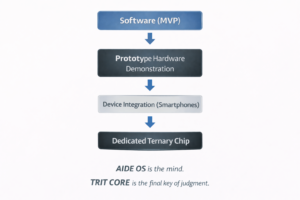
⑥ TRIT CORE Evolution Roadmap
Roadmap Rationale
The TRIT CORE architecture is designed to evolve progressively:
• Integration into consumer and enterprise devices
• Dedicated ternary chips for native, low-latency decision enforcement
• Software-based validation for rapid iteration
• Hardware demonstrations to prove real-world enforceability
TRIT CORE is designed to operate on today’s binary infrastructure,
while preserving a clean migration path to future ternary hardware.
This roadmap ensures that structural safety scales from theory to physical execution environments.
9. Computational Foundation: Ternary Computing
Binary execution models are insufficient to represent ambiguity, intermediate states, and evolving personality.
AIDE OS is designed to operate natively with ternary-state architectures, enabling:
TRIT CORE evaluates every proposed action as:
• Positive — execution allowed
• Negative — execution blocked
• Hold — execution deferred due to uncertainty
This makes uncertainty explicit instead of forcing premature binary decisions.
10. Governance, Transparency, and Responsibility
Guided by the principles articulated in the Hiroshima AI Process, AIDE OS embeds governance directly into system design:
• Traceable decision pathways
• Auditable internal state transitions
• Human-in-the-loop review points
• Clear responsibility boundaries
Control is not an external add-on.
It is part of the operating system itself.
11. What AIDE OS Is Not
Not a model. Not a guardrail.
An execution-time governance layer with HOLD.
AIDE OS is not:
a chatbot
a single AI model
a prompt-engineering framework
an autonomous AGI
a wrapper layer placed on top of an LLM
Unlike conventional guardrail software or API-level wrappers, AIDE OS governs execution authority at the system level.
It is the structural environment in which intelligence is allowed to exist responsibly.
12. From Theory to Implementation
AIDE OS serves as the bridge between theory and real-world systems:
• Personality-Based AI Bots
• AI Skill Certification Systems
• Long-term AI companions and digital legacy systems
• Governance-critical AI applications
All implementations inherit structural constraints defined at the OS level.
13. Vision
AIDE OS is designed for a future in which intelligence must persist, not merely perform.
It asks fundamental questions:
What does it mean for intelligence to endure?
How does personality remain coherent over time?
Where must responsibility ultimately reside?
AIDE OS is designed to enable this shift, bringing governed intelligence onto personal and everyday devices, including smartphones.
This vision naturally extends toward research on Artificial General Intelligence (AGI),
where long-term coherence, responsibility, and structural stability become indispensable.
AIDE OS is not about accelerating AI.
It is about making intelligence survivable, trustworthy, and human-compatible.
14. From Vision to Everyday Devices
AIDE OS is designed to move from theory to daily life.
Governed intelligence should not live only in the cloud.
Final judgment must reside on personal devices,where context, accountability, and human intention are closest.
This is how intelligence becomes trustworthy at scale.
コメントを残す